Tuesday, December 27, 2011

"The Soul of Ike & Tina Turner," by Ike & Tina Turner (October, 1961)


Dad's Take

This is Ike & Tina before Phil Spector's pop stylings. This album highlights the soul sound that brought them to fame. Ike had been around since before rock and roll had a name, with such early songs as "Rocket 88," but the smartest move he ever made was teaming up with Tina.

Musically, this album is a lot like Ike's early R&B music, with its roots firmly in the fifties. But it's Tina's vocal power and soul that makes this record a classic. Song after song, whether rocker or ballad, Tina sings, growls, and screams her way into the listener's soul. How can you not believe her sincerity, her feelings, and her pain, when she puts so much into her performances? Even the largely spoken (and less exciting) "Letter From Tina" had me saying, "Yeah, Tina, you're right. I'm sorry. Whatever you say."

Sonically, these aren't the clearest recordings ever. They sound like they're from an older studio. But it really doesn't matter. The somewhat muddy sound of some tracks adds to the grit of Tina's voice. It just wouldn't sound right with pristine digital clarity.

When you listen to this record (and if you haven't, you really should), there is no doubt that Tina is here to stay, that she's a force who will either self-destruct or be around for decades. As it turns out, Ike and Tina's relationship nearly destroyed them both, but Tina survived it and increased her status as a legend.

This early Ike & Tina record shows that Ike's R&B formula still worked, and that Tina is incomparable, in a tiny class with other legendary soul singers like James Brown and very few others.

Turn it up and marvel.

Brad's Take:


Now we're talking! After reviewing a couple albums that I didn't love, this is a breath of fresh air. I'm loving this album.

The opening song "I'm Jealous" is the perfect one to kick off an album like. It introduces you to Tina Turner's incredibly powerful voice right from the beginning. I couldn't help but get a huge smile on my face when she does her loud scratchy screams. It's great!

I love the overall vibe of this album. It's got soul, R&B, and early pop all mixed together to form one fun album from front to back. Ike and Tina really compliment each others styles.

Tina's vocals are my favorite thing about this album though. She has so much emotion and power in her voice that you feel intimidated by her. I'd never want to make her upset. You can tell that she doesn't need anyone else in order for her to shine.

Thursday, December 8, 2011

"The Shadows" by The Shadows (September, 1961)

Dad's Take:

This is a milestone of sorts in our reviews: the first album on our list to be released after I was born.

The Shadows were popular in Great Britain, but they never caught on as well here in the United States. They are interesting because of the way they explored the new sounds that were possible with electric guitars. Like many guitar bands of the period, they chose the somewhat twangy sound delivered by Fender instruments.

At times their instrumental tunes remind me of the "fake" rock and roll heard in sitcoms and low-budget movies of the time. But that's not quite fair. They helped to establish the two guitars/bass/drum combo as the standard lineup. They brought together a certain light jazz and light rock feel, combined with a skiffle background, to create a sound that was fresh at the time. And on the occasional vocal song, like "Baby My Heart," they previewed the sound that took over the world with the British Invasion a couple years later. "All My Sorrows" could be the Kingston Trio gone electric. And "That's My Desire" reminds me of the great songs of Roy Orbison.

But the Shadows were mainly an instrumental group, and it's there that they shine. They coaxed new sounds from their Fenders, though reverb, palm muting, bending, and just plain fine playing. Something like "My Resistance Is Low" had never been heard before, and classics like "Sleepwalk" sparkle with the new sounds.

The Shadows are not well known these days, but if you like the early sixties music, and especially instrumental groups like The Ventures, give them a listen.

Brad's Take:


I feel like I've listened to this album before. To me, it sounds like a big salad made up of a lot of the music that we've listened to so far.

Like my dad already said, "All My Sorrows" sounds like it could  be on a Kingston Trio album. It's slow, country-tinged, and full of vocal harmonies. "Shadoogie" sounds very reminiscent of Duane Eddy's surf guitar style. Songs like "Nivram" and "Theme From A Filleted Place" sound like they're in the style of Chet Atkins. Lots of twangy finger-picking. But all the "shadowing" aside, I need to try and give this album a fair review...

The Shadows do a great job at writing diverse songs. They've got a nice mix of fast songs, slow songs, and instrumental songs. They're known for their guitar playing though. They experimented with a lot of different sounds that eventually became popular.

Although the album's songs don't sound very different from earlier ones we've listened to, it still has a lot of originality and experimentation. It's good, but not great, and it's a little too all over the place for me.

"Joan Baez" by Joan Baez (October, 1960)

Dad's Take:

It's interesting to follow an established folk trio with the debut from one of the quintessential new breed of folk singer who arose in the early sixties. Joan Baez signaled the new era of the bare bones solo singer-songwriter (a little ironic since the songs are mostly folk standards, not Baez originals).

This album was recorded in a hotel room, with Baez, her guitar, and guitarist Fred Hellerman. It exhibits the folk sincerity that is sometimes parodied when people make fun of folk, but the performances are strong. Where blues and jazz records might conjure up the feel of a smoky bar room, this style of folk evokes a Greenwich Village coffee shop, full of beatniks and soon-to-be hippies, navel gazing and trying to out-deep each other in conversation. Not that there's anything wrong with that.

Baez has that prototype young woman singer-songwriter voice that continues to this day. It's not one of my favorite voices, but it works perfectly with the songs and simple arrangements of the material. Her best work was yet to come, but this record is a solid announcement that a new musical force had arrived. This doesn't feel like a debut. In classic folk songs like "Donna, Donna," "Wildwood Flower," and "House Of The Rising Sun," the 19-year-old Baez performs with confidence and sincerity, opening the door for the great new folkies of the sixties.

Brad's Take:


This sounds like it was recorded today. I had to double-take that it really was released in 1960. Like my old man said, her vocal style is copied in a lot of today's female fronted folk music. It, too, isn't my favorite vocal style ever, but it works for what it is. VibratoOoOoOoOoOoOo! I can see the flower people poking their heads out from behind the trees wondering what this new sound they're hearing is.

I have never been a big fan of singer-songwriter kind of folk music. I'd take the Kingston Trio over this any day. I didn't love this album. I didn't even like it, really, but I can see why it is a classic album. It's a style that was new and fresh at the time, but became a leading one near the end of the 60s.

It isn't bad. It's just not my cup of tea. All the new-school indie kids and hipsters would love it though.

Wednesday, December 7, 2011

"Eddie Cochran Memorial Album" by Eddie Cochran (September, 1960, UK only)

Dad's Take:

This album was released to memorialize (or capitalize on) Eddie Cochran's death in a car crash in April, 1960, at the age of 21. It's a solid reminder of how good Eddie Cochran was and how much he'd done at such a young age.

Although Elvis's influence is strong, Cochran was much more than an Elvis copycat. He was an amazing talent on his own, and influenced guitar players like George Harrison, who, like Cochran, played a semi-acoustic Gretsch with an unwound third string.

Cochran's songs have been copied by many artists over the years. "Summertime Blues" is his best-remembered and most copied record, but his influence goes beyond that one song. One of the rockabilly greats, Cochran was copied by almost everybody in the sixties--especially the great British rockers like the Beatles, The Who, the Stones, and Led Zeppelin--if not in direct covers, then in style.

This album makes it clear why Cochran is in the Rock & Roll Hall Of Fame. Whether the song is well known, like "Summertime Blues" or "C'mon Everybody," or less known like "Somethin' Else," his performances are strong, energetic, and more original than some might claim. His influence on the second generation rockers is indisputable.

Check him out yourself if you don't believe me.

Brad's Take:

On songs like "Jeanie, Jeanie," you can definitely hear the Elvis influence in Eddie Cochran's music. He even sings "blue suede shoes" in the lyrics to that song which instantly reminds one of Elvis' song. But even if Eddie borrows Elvis' musical style a little bit, he's no Billy Fury. Cochran makes his songs his own, maybe except for the song "Pretty Girl."

"Hallelujah, I Love Her So" is a song I liked instantly. It's upbeat and has a loud strings section accompanying the other typical instruments. The violins really made that song stand out to me.

"Summertime Blues" is a classic that everyone knows, even if they just know the hook. This song shows that Cochran was original and not an Elvis Presley copy cat. This song is a solid golden hit that I don't even think The King could have written.

For me, this collection of songs is hit and miss throughout. I liked just about half of it, and the other half, I could have done without. Even though there are some songs that I didn't love, this is a great collection that shows off all of the sides to Eddie Cochran.

It's hard to believe that he was 21 or younger when he wrote all of these songs. The kid had true talent, and it's a bummer that he died so young. It would have been really interesting to see where he would have gone next.

"String Along" by The Kingston Trio (July, 1960)

Dad's Take:

We've covered just about every genre in popular music so far, so it's about time we move into folk music, one of my favorite genres. What better place to start than The Kingston Trio.

The Kingston Trio peaked commercially with "Tom Dooley" in 1958, but this album, their fifth studio record, captures everything I like about the trio. It has impeccable harmonies, humor, social awareness, and catchy melodies. By 1960, folk had been popular for a few years among the college crowd who where a little too old for rock and roll's dance beat, but it was only on the verge of becoming the force it would be with the ascent of Dylan, Baez, and the rest of the sixties folk icons.

The Kingston Trio were among the pioneers of modern folk music, and "String Along" makes it clear why. Great songs like "Leave My Woman Alone" are accessible to the aging first generation of rock and rollers (and, indeed, were influenced by people like the Everly Brothers), but with a maturity and social awareness that had not yet broken into rock and roll music. Those things would become part of rock and roll soon, thanks to people like The Kingston Trio and their influence on a folk scene that would soon give birth to Dylan and his cult of followers in all popular genres.

But back to the Trio. Not long after this album was recorded, Dave Guard left the Kingston Trio, putting an end to the first major era of the Trio. He was replaced by John Stewart, who I always liked as a member of the Trio and as a solo act. They weren't quite the same after that. They continued to have chart success for a couple more years, but "String Along" was their last album to top the charts. Six of their next seven albums hit the Top Ten, though, so Guard's departure definitely didn't kill the group.

I'm not sure why this is the album the authors of our list chose to represent the Kingston Trio, but I'm not complaining. I've never hear this whole album before, and I'm happy to have it now. "String Along" is a good, solid album, with strong songs and very little obvious filler. Like other Kingston Trio albums, it was criticized by some folk fanatics because of its political neutrality in a left-leaning genre, but record buyers ate it up and found it highly satisfying. It's a very good record.

Brad's Take:


Like a lot of the albums we've reviewed so far, I've heard of the band, but never actually listened to any of their music, until now. Although folk music isn't typically my cup of tea, this was a nice little surprise.

"Bad Man's Blunder" is an up-tempo silly little song that I thought was okay, but the next couple of tracks were a bit slower, and full of perfect harmonies. I liked all of the slow songs the most on this album.

They have great voices that sound great when they're harmonizing together. On songs like "When I Was Young," they harmonize the entire song together. It reminds me a lot of a band I occasionally listen to called Kings Of Convenience, who must have at least some Kingston Trio influence in their vocals.

 As a whole, this album is good. It's not my favorite, but there's some songs that I really liked a lot, and some that I sort of struggled to get through. Fortunately though, the entire album is only 30 minutes long so the songs are short and sweet, getting to the point from the get go.

Sunday, December 4, 2011

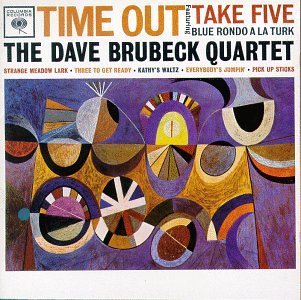
"Time Out" by The Dave Brubeck Quartet (June, 1960)

Brad's Take:


Dave who? That's what I thought when I got to this on our list. But right when the first track began, I knew I was going to remember Dave Brubeck from then on.

On the opening track, "Blue Rondo A La Truk," I was taken by surprise. Dave Brubeck shows no mercy on that piano! He pounds on it like each of his fingers are hammers, but then, out of nowhere, he turns his hammer-hands into cooked baby carrots which make for a very delicate and soft sound, of course.

This is a great jazz album. It's got the upbeat swing stuff all the way down to the mellow nighttime "I'll be in the back of this empty, cold, dark bar at a table sipping a drink all alone" stuff. And sometimes all those different jazz sub-genres come together in single songs. Also, to make it more fun and interesting for the listener, and probably the band itself, they wrote stuff in super weird time signatures that I can't even comprehend, and even showcased Joe Morello's awesome boomy drum solo in the middle of the song "Take Five."

Although this album got negative feedback from critics when it was originally released, there's no surprise that it eventually made its way on to lists such as "1001 Albums You Must Hear Before You Die."

Dad's Take:

This is the kind of jazz I like. I like how Brubeck and his quartet explore everything from traditional jazz to swing and blues and even a bit of R&B and waltz music, all within a single number. It's like nothing is off limits, and they're going to go wherever the music leads them. The goal of "Take Five" was to explore unusual time signatures, and Brubeck succeeds, going all over the place but without ever becoming unlistenable. Everything fits together so well that you hardly even notice that this is experimental music. You can't get bored when the music captures your attention and creates suspense that makes you think it will go one way, and then it twists in an unexpected direction. To me, that's just plain fun.

Brubeck's piano leads the way, but he gives plenty of time to the rest of his combo. Paul Desmond on alto sax adds musical candy, with extra sweetness from Eugene Wright's restrained bass and Joe Morello's steady-but-never-monotonous skins. Brad pointed out Morello's solo on "Take Five," which is one of the most musical drum solos I've ever heard.

"Take Five" is the best known piece here, and it is sheer delight, but it's not the only cut worth listening to. The album is solid from beginning to end. It might be a step below Miles Davis's "Kind Of Blue," but it's a very small step.

"The Sound Of Fury" by Billy Fury (May, 1960)


Brad's Take:


I'd never heard of Billy Fury before this so I was curious to hear his debut album, "The Sound Of Fury." As soon as I hit play, I immediately thought, "I didn't know Elvis impersonators actually got record deals..."

After doing a little bit of research, I discovered that he kind of was Elvis, but the UK's version of Elvis. His vocal styling and energy is almost identical, and he even dressed and moved like The King.

On "Turn My Back On You," Billy Fury does his best Buddy Holly impression by doing the stuttering vocal style that Buddy was well known for.

Since our book is from the UK, it makes sense for Billy Fury to be in it. The UK needed an Elvis and a Buddy Holly so this kid probably made lots of people (especially girls) happy until the real came over from the states.

Putting the similarities to other artists aside, Buddy, I mean Billy Fury nailed it on this album. He stuck to the same blues/rock/country formula that was popular in the US and brought it to the UK, and he succeeded. His voice and energy were great, and he was a good looking guy. I'm sure the English girls swooned over him all day and night. It's not a surprise that a life size bronze statue of him (doing an Elvis impression) was eventually built in Liverpool in his honor in 2003.

Dad's Take:

This is one of a few British-only releases on our list. It's a British book, so that's to be expected. It's also interesting, because it ensures that we'll hear some albums that we've never heard, but that influenced the great British bands. Billy Fury, as an early leader in the Liverpool rock and roll scene, undoubtedly played a more important role than we Yanks are likely to recognize. Interestingly, according to one source, one group that auditioned to be Fury's band was a little band called the Silver Beetles. They were turned down when they refused to fire their bass player, Stuart Sutcliffe, thus missing out on a £20 per week job.

If you listen to very much 1950's rockabilly, you'll hear a number of Elvis imitators of varying quality. Billy Fury is actually pretty good. The songs are good, and the performances are strong. As Brad mentioned, you hear the obvious influence of people like Elvis and Buddy Holly, as well as Carl Perkins and other rockabilly greats, especially Eddie Cochran.

Fury had the chops to pull off some really good rockabilly, as well as the voice for ballads. He didn't have quite the same energy level as Elvis or Buddy. His music isn't especially original, but he was one of the early architects of British rock and roll, and as such deserves a spot on our list.

Bottom line, though, is that it's just a fun record. Songs like "Don't Say It's Over," "That's Love," and several others on this record deserve to be better known stateside. I found "Since You've Been Gone" with its bizarre tempo changes and stuttering "baby baby baby" delivery to be especially interesting. It's not the best song on the record, but it's unusual and fun in its weirdness. If you like good old rock and roll, and especially rockabilly, look for this record. It's good stuff if you like this kind of thing. And I do.