Tuesday, October 13, 2015
"Blackboard Jungle Dub" by Lee Perry and the Upsetters (1973)
Dad's Take:
Lee Perry was pioneer of dub music, taking sounds he and dubbing them into innovative reggae music. This album originally had a very limited release, 300 copies, and sold only in Jamaica. That it has managed to build a cult following worthy of a classic albums list is pretty amazing.
OK, I have to admit it. Everything in that previous sentence led me to dread this review. This really isn't my kind of thing. But I didn't need to be afraid. It's actually a pleasant listen, although it's also very long and quickly starts to all sound the same.
It's really not so bad. It reminds me of some of those tropical sounds albums we did early in our attempt to review everything in this list. It makes for some interesting listening, and sometimes the sounds capture my imagination.
The problem is, this is so long, and that rhythm starts to sound monotonous very quickly. So, I'm listening to the whole album, and enjoying parts of it, but I have to admit, I'm really kind of bored. Nothing really stands out. It's just one long groove, kind of cool at times, but mostly it just grows old fast. I know there are probably devotees who would jump all over me for this review, but, you know, people like what they like, and this just does very little for me. It doesn't affect me emotionally or interest me intellectually.
I don't know what else to say. This just isn't the kind of music that holds my attention for 14 songs (18 on our expanded edition). I'm not saying it's bad. It might even be great. If it weren't so goldern long I might even actually like it, kind of. But, sorry dub fans, this just isn't for me.
Brad's Take:
The purpose of my dad and I starting this blog was to the show how generation gaps might affect reviews of a particular album. There's been a lot of albums so far where my old man loves an album, but I have a total opposite opinion, and that's what makes this blog the most interesting, usually.
This will not be one of those interesting reviews.
Dub music (or reggae, or whatever you're supposed to call this) is so far out of my comfort zone and personal taste. I just can't get into this at all. I can't even pretend to be optimistic about it. I have absolutely no interest in this style of music.
I think it's safe to say that you won't be seeing me or my dad at any reggae/dub festivals anytime soon.
"Talking Book" by Stevie Wonder (October, 1972)
Dad's Take:
The 1970s turned out to be a great decade for Stevie Wonder, and really started with this record, his 15th album.
Fueled by two monster hits "Superstition" and "You Are The Sunshine Of My Life," Stevie left Little Stevie Wonder behind and showed that he was a grown-up musical force to be reckoned with. This is where he became a superstar. This was hist first album to reach #1 on the R&B charts, and it made #3 on the Pop charts. It also took home three Grammys at the 1974 awards (the same year his next album, Innervisions, won album of the year). Obviously, Stevie Wonder dominated 1973, and it all started with this release in October, 1972.
Any album that starts with a classic megahit love song like "You Are The Sunshine Of My Life," has a lot to live up to. Sometimes it's hard to get beyond the kind of sappy lyrics and notice the jazzy rhythm section that drives the song. It's just a good one, all the way around.
But once Wonder gets passed the obvious radio hit that naturally starts the album, he hits a funky groove that shows he is more than a hit machine, that he's an innovative master of R&B. Today's R&B artists owe a huge debt to Stevie Wonder. While many of the songs seem locked very much in their time period, mainly because of the very-seventies electronic keyboards, others transcend the calendar and could have been laid down any time from the late sixties to today. "Maybe Your Baby" could have been sent back in time from now, especially vocally. But it's really the backing track that makes it for me, with the big Moog bass sound and the funk guitar, and interesting rhythms. I dare you to try to do something else while this song is playing.
The album goes on like this, combining gentle jazzy love songs with big R&B numbers, showing both sides of Stevie Wonder, and never getting boring because of the sameness that dominated some other albums of the period. There are also plenty of the social messages that have always been found in soul records. "Big Brother" is the obvious example here. Wonder is versatile, and his talents as a songwriter and multi-instrumentalist drive this record.
Of course, for me, the album is dominated by the monster sounds of "Superstition." What a song that is! Even after all these years, it's timely and modern and just plain Funky with a capital F. The kind of song that, if you do nothing else in your career, you'll be known as a legend because of this one record.
This is a great album. Sure, today parts of it sound dated, but certain sounds become associated with a specific time period because they dominated that time, and dominant albums are usually classics. It's hard, though, to imagine where modern R&B would be without the influence of this and other Wonder albums. And, as good as this is, it's hard to believe how much bigger Little Stevie was going to get over the next few years.
Brad's Take:
First off: It's crazy to think that in the early 70's Stevie Wonder was already releasing his 15th album. Was this guy releasing music since the beginning of time? What a machine!
The album opens with the super popular (and super dated) "You Are The Sunshine Of My Life." It's a cute song, but a great classic song? I dunno. The dated-ness of a few of these songs (mostly the slower ones) really took a toll on my patience and willingness to get through this. Blame it on the generation gaps before you strike me! Fortunately though, the great songs are actually really, really great!
"Maybe Your Baby" is definitely a highlight on Talking Book. Ray Parker Jr. (the Ghostbusters song guy!) plays some mean electric guitar on this heavy funk jam. If this song was peanut butter, it'd be extra chunky. "Tuesday Heartbreak" is another one of the great up-beat tunes on here that I really enjoyed.
But let's get real... "Superstition" takes the top highlight spot. That song still rocks! Totally timeless, Everything about that song is perfect,
Even on the very few doozies on Talking Book, Stevie's voice is what really carries the album. His voice and the emotion he packs behind it really makes his music shine. That voice is just "wonder-ful", even still.
Sunday, August 16, 2015
"Nuggets: Original Artyfacts from the First Psychedelic Era, 1965-1968" by Various Artists (September, 1972)
Dad's Take:
For most sets like this, I'd complain about a various artists compilation being on a classics albums list, even when I really like the music, as in this case. But this compilation belongs on the list, for two reasons.
First, this set was very popular. It led to sequels, and eventually to a series of CD box sets, some of which I have. Popular does not necessarily equal classic, but in this case, because the album is full of classic music that often came from small labels and short-lived bands that didn't necessarily release classic albums (or even albums), I'll let this one in.
Second, and most importantly, this compilation was hugely influential. Although the subtitle and cover art make it look like this album contains a bunch of psychedelic music--and it does--the record is most notable for its sizable collection of late-sixties garage bands. Why does this matter? Because the re-emergence of these lost garage classics led directly to punk music, one of the biggest movements to grow out of the seventies, one that is still dominant today. In fact, the liner notes for this package contain one of the first usages of the term "punk rock."
Songs like "Dirty Water," "Night Time," and many of the others on this record, are clear predecessors to punk. Seminal punk bands like the Ramones ate up these garage classics from the sixties, sometimes even covering the songs.
I'd talk about all of the songs I like, but there are too many to list in this 27-song compilation. And they don't really matter. It's more about the movement and the unburying of lost songs that often appeared on small, local labels. I'll mention a few songs, though. Like "Psychotic Reaction" by the Count Five, a band that I can attest to being a garage band because they used to practice in a garage on my grandparents' street in San Jose, California, where I remember seeing them at least a couple times when I was but a wee lad. I wasn't impressed, but I was like six. I like their song now.
And then there's the Brian Wilson/Smile inspired beauty of "My World Fell Down" by Sagittarius, featuring sometime-Beach Boy Bruce Johnston. It's a great song. "Pushin' Too Hard" by the Seeds is pure protopunk. "A Public Execution" by Mouse & the Traps, the somewhat exhausting "Run, Run, Run" by the Third Rail, "Tobacco Road" by Blues Magoos, the blues classic "Baby Please Don't Go" as performed by Ted Nugent's band, the Amboy Dukes, "Open My Eyes" by Todd Rundgren's band The Nazz--these are all just great songs. And there are so many more. It's fun to look up these bands, most of which are barely remembered, and see how many of them include musicians who later became famous.
So, although a various artist compilation, like a greatest hits package, might technically be cheating when included on classic album lists, I won't argue with this one. Arguing would just take away from my listening time, and I love listening to this one. I even think that Brad, not a fan of psychedelic music, is going to find a lot of groovy tunes to dig in this one.
Brad's Take:
Well, my dad was right. I did enjoy this!
It's obvious that this compilation came out at the peak of the Beatles initial success in the mid-60s because a lot of these bands sound a lot like them. Like, a lot. For example, The Knickerbockers' track "Lies" sounds very early-Beatles-ish. I guess when it comes to mid-60s garage bands, it only makes sense for them to be influenced by the biggest bands at the time, especially The Beatles, as this collection consists of songs that came out right after the Beatles came to the U.S. for the first time. Basically, if you like the early Beatles music, you'll most likely dig this entire album.
The Beatles aren't the only band with obvious influence on a lot of these bands though. "Don't Look Back" by The Remains sounds a lot like a song The Rolling Stones would have penned in their early days. The vocalist even emulates a bit of Mick Jagger. Also in a good way.
On this compilation, when the songs don't sound Beatles-esque garage rocky, they are your typical 60's psychedelic pop/rock, which I don't gravitate to as much. I don't think any of the songs on this collection really bothered me at all though. Despite its length, this was a pretty enjoyable listen front to back. There are definitely a few bands on here that I'd like to check out more.
Sunday, June 14, 2015
"Foxtrot" by Genesis (October, 1972)
Dad's Take:
Back before Genesis became an icon of Eighties pop radio, they were a groundbreaking, if sometimes dull, progressive rock band. This particular album, their fourth, is more proof that the list we're working from for these review comes out of Britain, because this particular album, which hit number 12 on the UK charts, did absolutely nothing here in the US. But, hey, it was #1 in Italy.
I have to admit that I've never been much of a fan of Phil Collins's singing, although I think he's a very talented and very funny dude. That bias prejudices me against much of Genesis's work, maybe somewhat unfairly. But people like what they like.
That said, this is a pretty good record, for what it is. It's more accessible to a pop/rock ear than some prog rock is. Sure, it lacks that working-class edge that most of the best rock and roll has, but it is a musically interesting album, with meaningful (if sometimes somewhat obscure) lyrics. There's some real rock here at times, and there are indications that Genesis had some serious radio potential, as they proved later in their career. I like the whimsical pseudo-medieval-fairy-taleism of some of the songs.
I'm actually enjoying this album, but I'm not loving it. There are bursts of brilliance. I think the highlight for me is the "Willow Farm" section of the "Supper's Ready" suite that ends the record. That section is funny and dramatic and I like it. And then, at other times, I find my attention being easily drawn away to other things. I like that there's plenty of rock in their prog, but I'm hearing very little that makes me fall in love with the record.
I'm afraid this is like a pleasant first date that is fun while it lasts, but you know it's not going to go anywhere so you just try to have a good time while you're there. And, yes, one of the reasons is the rather annoying whine of that Collins voice. And the keyboards that sometimes remind me of the old Disneyland Main Street Electrical Parade. Maybe if I went back to this one for a second date, there could be a more meaningful connection, but I feel little compulsion to try it again. Now that I've listened to it all the way through and I know what it contains, if I feel the right mood and have nothing better to do, I might give it another shot. There really is some good stuff here, so I'll keep its number in my little black book.
But, really, if I were Genesis, I wouldn't sit by the phone waiting for me to call. I guess I'm just not that into you.
Brad's Take:
Like most people my age, I pretty much only know Genesis for their album Invisible Touch. In fact, I forget that they were around LONG before that album came out in (the year of your Bradley) 1986. Their popular songs from the 80s are the sound I know them for, so this album was a surprise to me.
Also, I always forget that before Peter Gabriel wrote "In Your Eyes" he was the lead singer of Genesis for a long time. Fortunately, he takes on lots of the vocal duties on this album. So does drummer Phil Collins though.
I don't hate Phil Collins' voice as much as my old man does, but I feel like it Peter Gabriel's works much better for this particular style of music. Phil's voice makes a lot more sense on the poppy 80s tracks that I know him best for. I can't even get into the Disney Tarzan movie that Phil Collins did all the music for. Something about the soundtrack drives me absolutely nuts. It's just too much Phil, I guess.
These prog rock albums are hard for me to get through willingly. I have music A.D.D. or something because when I see a song is over 5 minutes, I get very weary of it. And this particular album only has 2 tracks that are under 5 minutes, and a closing track that is 23 minutes long.
It's hard to tell if I have favorite/least favorite songs on here. Each song has parts that I liked a lot, but just as many parts that I thought were really terrible. If I absolutely had to pick a couple songs to go back to, I'd probably choose "Get Em Out By Friday" and "Can-Utility And The Coastliners." Those two songs had a lot of really enjoyable parts in them.
Overall, I think I'll stick with Invisible Touch.
"I'm Still In Love With You" by Al Green (October, 1972)
Dad's Take:
This album brings back memories. I didn't have the record back in the day, but some of the songs were radio staples, and the sound is so typical of early seventies soul that it was everywhere, whether performed by Green or his contemporaries. It topped the Billboard R&B chart, and hit #4 on the Billboard Top 200.
Al Green has this smooth, classic soul voice, and the songs are perfect for his vocal stylings. The title song, for example, is everything you need to know about soul love songs in 1972 wrapped into one tight little package: not too deep, not too poetic, but loaded with emotion and, well, soul. The other hit, "Look What You Done For Me," is, not surprisingly, a radio-friendly love song punctuated by those early seventies horns and a soft and gentle groove. The second song on the record, "I'm Glad You're Mine," isn't one of the stronger songs, but it still has this cool funky groove that you don't always hear on a ballad, a little reminiscent of Sly Stone. Even Roy Orbison's "Oh, Pretty Woman," gets a groovy soul update that works pretty well. And who knew that the other cover on the album, Kris Kristofferson's "For The Good Times," could be so soulful? But then, Ray Charles already showed us how full of soul a country song could be.
The album is full of songs created in that vein, with Green delivering easy soulful ballads full of his smooth singing and tight, emotional squeals. There;s a sameness (or a unity, if you prefer) that makes the songs flow together, with nothing that jumps out and spoils the mood that the record creates. Typical of this genre, the songs aren't as much about the music or lyrics as they are the vocal stylings, the singing and the little sounds--the squeals and growls and moans--that create the feeling that the songs are trying to convey. At his best, Green was a master of the soul delivery.
If you like your soul on the softer side, or if you're just in The Mood, put this one on. It's such a cool, mostly mellow album full of gentle soul funk. It sounds like sleeping in with your honey late on a Sunday morning.
Brad's Take:
The album art should have been Al Green sitting on a bed, rather than him alone in a chair. It would have been a lot more fitting for these sexy 35 minutes.
The album never drifts away from the 70's sexy-time soul style, which makes it very cohesive. If you like one song, you'll like them all. However, there were still a couple songs that stood out to me. "Love and Happiness" has a really nice beat and groove. "Simply Beautiful" is extra soft and extra sexy, like he is whispering right into the girl's ear that he's singing to. And of course, his twist on the Roy Orbison classic "Oh, Pretty Woman" is a highlight and is very fitting for this album. And like I said, if you like one song, you'll like them all. There isn't a song on here that I didn't enjoy.
I've never gotten into Al Green before this, and I'm kind of disappointed in myself for it. I see this specific LP at an antique store that I frequent whenever I am in the mood to shop for old used records. For whatever reason, I notice it every time I am sifting through the records, and now I realize that I should finally pick it up since it's always caught my eye, now that I know it catches my ear too.
Thursday, June 4, 2015
"School's Out" by Alice Cooper (July, 1972)
Dad's Take:
I like Alice Cooper as much as the next guy my age, but I have to admit, I was surprised to find him on our list. It's almost like the schlock of his act is being taken seriously. Not that that's a bad thing. Thing is, he's fun, and he did some pretty good songs.
It's funny that this one follows Bowie in the list, because Alice Cooper is, in many ways, the dark side of the Bowie coin. It's really clear when you listen to the two albums back to back. Alice Cooper emphasizes the male posturing and the projection of danger, where Bowie lets the feminine side of rock and roll out of the closet, but Alice still hides his strut behind a Bowie-like androgeny, only less pretty. The second song on the album, "Luney Tune," even reminds me a bit of "Suffragette City" and explores some of the same themes as Bowie does with his Ziggy Stardust alter-ego. Also like Bowie, Alice Cooper helps to usher in the weird cheeseball that was the last 2/3 of the seventies.
The stand-out tune on this album is no surprise. "School's Out" was a huge hit. Even those of us who liked school were sucked in by those dorky lyrics of rebellion, the anthem for the end of the last day of school for the rest of the decade. "My Stars" and "Public Animal No. 9" are vintage Alice as well.
This album doesn't take itself too seriously, and yet it pushes the limits in its own way. The Marilyn Manson of my generation comes off as a comic book character now, but at the time, he actually scared people with his act, like Manson would later. But behind it all was a highly image-conscious performer who understood how to commercialize his image, and who had a tight band to help him do it.
This isn't straight-up rock. The music is surprisingly creative. Just check out the instrumental break of the Broadway parody "Gutter Cat vs. the Jets," a song that always makes me laugh. That's followed by the Batman-like (the sixties version) music of the "Street Fight" between those gutter-cats (there are even meow sound effects) and the Jets. West Side Story goes rock, and it's funny and weird and entertaining.
The rest of the album is like that. Seventies hard rock meets Broadway show tunes, with some surprising instrumental bits that are inspired as much by Fosse as they are by Ozzy, even when they rock. It's corny, schlocky, cheesy, stupid, smart, bombastic, dorky, subtle as a stubbed toe, and a whole lot of fun.
A classic? Sure, why not? It illustrates the period when it was made very nicely, and isn't just another cookie-cutter rock album.
Brad's Take:
I like Alice Cooper as much as the next guy my age, but I have to admit, I was surprised to find him on our list. It's almost like the schlock of his act is being taken seriously. Not that that's a bad thing. Thing is, he's fun, and he did some pretty good songs.
It's funny that this one follows Bowie in the list, because Alice Cooper is, in many ways, the dark side of the Bowie coin. It's really clear when you listen to the two albums back to back. Alice Cooper emphasizes the male posturing and the projection of danger, where Bowie lets the feminine side of rock and roll out of the closet, but Alice still hides his strut behind a Bowie-like androgeny, only less pretty. The second song on the album, "Luney Tune," even reminds me a bit of "Suffragette City" and explores some of the same themes as Bowie does with his Ziggy Stardust alter-ego. Also like Bowie, Alice Cooper helps to usher in the weird cheeseball that was the last 2/3 of the seventies.
The stand-out tune on this album is no surprise. "School's Out" was a huge hit. Even those of us who liked school were sucked in by those dorky lyrics of rebellion, the anthem for the end of the last day of school for the rest of the decade. "My Stars" and "Public Animal No. 9" are vintage Alice as well.
This album doesn't take itself too seriously, and yet it pushes the limits in its own way. The Marilyn Manson of my generation comes off as a comic book character now, but at the time, he actually scared people with his act, like Manson would later. But behind it all was a highly image-conscious performer who understood how to commercialize his image, and who had a tight band to help him do it.
This isn't straight-up rock. The music is surprisingly creative. Just check out the instrumental break of the Broadway parody "Gutter Cat vs. the Jets," a song that always makes me laugh. That's followed by the Batman-like (the sixties version) music of the "Street Fight" between those gutter-cats (there are even meow sound effects) and the Jets. West Side Story goes rock, and it's funny and weird and entertaining.
The rest of the album is like that. Seventies hard rock meets Broadway show tunes, with some surprising instrumental bits that are inspired as much by Fosse as they are by Ozzy, even when they rock. It's corny, schlocky, cheesy, stupid, smart, bombastic, dorky, subtle as a stubbed toe, and a whole lot of fun.
A classic? Sure, why not? It illustrates the period when it was made very nicely, and isn't just another cookie-cutter rock album.
Brad's Take:
Alice Cooper is one of the most well known classic metal guys around. I immediately recognize him when I see him in a magazine or on TV. He's just one of those house hold names. He was like the Marilyn Manson of the 70s. But listening to his album School's Out, I came to the realization that I don't really understand why he is so popular anymore. I only know (and like) just one of his songs. At least from this particular album.
"School's Out" is probably the only song I could ever name off the top of my head, before (and after) listening to this album. That song was the only one that stood out to me across this whole album. Maybe because it's the only one I knew, or maybe because it was the only one I enjoyed, but something about this album just didn't do it for me. I think a lot of that had to do with the fact that it didn't sound any different than the other "stoner metal" from around this era, like Black Sabbath, but with a dash of David Bowie's weird experimental spacey stuff. Despite only recognizing one of the tracks, I felt like I had listened to this album a dozen times already.
I really don't have much else to say about it. Nothing surprised me, except for the fact that this album even made the list of "classic albums." It must only be because of the massive title track. Unless I'm completely missing something and it just went over my head.
"School's Out" is probably the only song I could ever name off the top of my head, before (and after) listening to this album. That song was the only one that stood out to me across this whole album. Maybe because it's the only one I knew, or maybe because it was the only one I enjoyed, but something about this album just didn't do it for me. I think a lot of that had to do with the fact that it didn't sound any different than the other "stoner metal" from around this era, like Black Sabbath, but with a dash of David Bowie's weird experimental spacey stuff. Despite only recognizing one of the tracks, I felt like I had listened to this album a dozen times already.
I really don't have much else to say about it. Nothing surprised me, except for the fact that this album even made the list of "classic albums." It must only be because of the massive title track. Unless I'm completely missing something and it just went over my head.
Tuesday, May 5, 2015
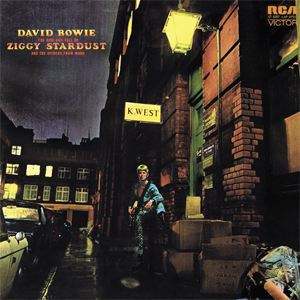
"The Rise and Fall of Ziggy Stardust and the Spiders from Mars" by David Bowie (June, 1972)
Brad's Take:
I might be in the minority here, but I didn't enjoy this one as much as Hunky Dory. The first half was hard for me to get through. I pushed through it though (fortunately) because the last half of the album is mostly pretty great.
"It Ain't Easy" was the first song that I got to on here that I actually liked, and after that pretty much every song was enjoyable to me. I think I liked "Star" the most though.
To me, "Star" sounded like a song that a "rock n roll star" would sing in their own head while standing center stage, looking over a massive crowd. It almost sounded cocky, in a way. I liked it a lot though.
I think I'm beginning to get a decent idea of what David Bowie is all about now. I know that we have a few more Bowie albums coming up soon on our list, and I'm afraid all of my reviews of his album are going to be very similar. Hopefully he will surprise me soon because at this point I just don't really see the appeal yet.
Dad's Take:
I like the concept of this album, with the singer taking on the persona of a stranger in a strange land. Being a foreign observer means you can say stuff that others might not say about what you're observing, to explore themes that are not always talked about in the macho world of early seventies rock, like bisexuality and the phoniness of image.
The only problem is, I never quite believe it here. There's not doubt that Ziggy is Bowie wearing a mask, and that he loves that image, even when he knows it's phony. That's OK, but stories are always better when the author doesn't make himself so obvious. I forgive him though, largely because I've always really liked "Starman." Of course, the big hit here is "Suffragette City," which earns its popularity but stands out a little too much from the rest of the album, like "Changes" does on Hunky Dory. For me, this album has always been about "Starman." There are quite a few other great songs here. There's the T. Rex-like "Hang on to Yourself," the mood-setting "Five Years," which opens the album. "Ziggy Stardust" is a cool bit of pre-eighties glammy space rock in all its cartoon-like glory.
Bowie may be my generation's Oscar Wilde, so hiding in the shadows of his own work is not likely to happen. And as Oscar Wilde would have, Bowie cuts through one of the truths about metal bands--that behind the overt masculinity was a lot of teenage boys enjoying the physical image of the performers, whose androgeny might not have been as obvious as Bowie's, but it was a big part of their appeal to a large segment of their audience. Bowie just made it more open, and by doing so, helped create the disco culture and, especially, the eighties. I think Bowie foresaw the revelation of what was behind the rock, and opened the door for the rest of the seventies and eighties by killing it off with "Rock 'n' Roll Suicide." And "Suffragette City" drew the rock fans in to witness their own demise, without realizing yet what was about to happen to the radio within a couple years.
All that aside, this album goes beyond the surface glitter and glitz of glam rock. It actually has some depth. Between the messages, the story, the concept, the rock, and the sheer creativity of the songs, it's an enjoyable listen. More than that, it rises to the level of essential for understanding the period and, especially, what was about to happen to seventies when the often empty shell of disco glam took over. I don't mean to imply that that's what this album is, at all. But I think it helped move us in that direction.
The album might not be one of my favorites, but it is pretty good. I think I might like this one better than Hunky Dory. I like the concept, and I think it holds together better as a complete album. Still, I don't think I can say I love it. I recognize it as an excellent album, and I enjoy listening to it. I like that there's more straight-up rock on this one. Unlike the last Bowie album we reviewed, I think this one is a classic in its own right, for what it is, not just for its influence on the following decades.
Subscribe to:
Posts (Atom)